Blog Archive

Showing posts with label JT Sawyer. Show all posts

Friday, August 7, 2015

Book 4 in the Carlie Simmons Post-Apocalypse Series now available for pre-order

Fort Lewis: the last bastion of civilization left in the western U.S.
The Undead: nearly seven billion hungry flesh-eaters roaming the world.
Carlie Simmons and her elite team: unstoppable and perhaps humanity’s final hope.

With research for the antidote underway, Carlie and her team at Fort Lewis face a new threat from an emerging force in southeastern Washington. A brutal army of former military prisoners, led by demented Lt. Colonel Ryan Mitchell, seeks to destroy all that Carlie and her fellow operators have fought for. Armed with a frightening technology for manipulating the faster-moving mutants, Mitchell will stop at nothing to control the Pacific Northwest. Amidst all of the chaos of open warfare at their doorstep, Carlie must face her own personal battles while racing against the clock to save what could be humanity’s last chance for survival and her own chance for love in a world spiraling out of control. The Gathering Darkness is the Fourth Volume in the Carlie Simmons Post-Apocalyptic Series and is now available on Kindle. Approximately 170 pages.

Sunday, February 8, 2015

Common Survival Myths & Misconceptions

Many readers email me about the survival skills that show up in movies or so-called reality shows. Being involved in educating others over the past 25 years, I thought I’d mention a few myths & misconceptions that have crept into the field of survival.

1) Can you really get water from a cactus?

There’s a reason you don’t find cactus juice at the grocery store. It’s a noxious substance full of alkaloids that can push a heat-stressed individual into heat-stroke. The few times I’ve tried this  method, to glean its supposed usefulness, has seen me nauseous. Carry water with you in the desert or hole up like a cowboy during the heat of the day until you can locate water. A person sitting in the shade in 90 degree F weather will expend six-quarts of water over 24-hours so there’s no substitute for being prepared in the wilds.

2) If the world falls apart, I can just grab my rifle and bug-out-bag and retreat to the wilds for a few years until society re-establishes itself, right?

Living off the land in a solo fashion is brutal. There’s a reason our ancestors lived in tribes- it takes a lot of people on the land to provide sustenance. It is far better to have some supplies on hand at home and then augment your pantry with any wild game, fish, or edible plants that you might be versed in obtaining. Even better than that is to have a like-minded group of family and friends that you can work together with to ride out such a disaster. I wish life in the wilds were like the romanticism found in the movie Dances With Wolves but it’s more like the harsh reality of the film, The Snow Walker.

3) I saw this TV show where the guy was lost and rubbed two-sticks together to start a fire. Is that possible?

None of us would be here today if our ancestors hadn’t mastered the fine art of friction firemaking but this is a skill to practice on camping trips and backyard outings. Modern survival is about being prepared and carrying at least three firestarters (Stormproof matches, spark-rod, and lighter) with you at all times when in the backcountry. I teach primitive firemaking skills to show my students how to perform the method but find that, even under the best of conditions, it is a challenge and not reliable for most people. This is not the method I want to use if I am lost, injured, or stranded in the wilds with the sun going down! I've worked as a consultant on several reality shows and, other than Survivorman, these shows are heavily scripted. On one program I was hired for, we had a crew of 12 people accompanying us, including two staff whose sole function was to tote around coolers filled with double-shot espressos and sandwiches while filming the host to make it look like he was living off the land. There's nothing romantic or fun about real survival- it's only adventure in retrospect.

4) My buddy said that if you’re thirsty, you should put a pebble under your tongue and that will help you stay hydrated. Does that really work?

This simply stimulates the saliva glands which can help get rid of cottonmouth (which in turn helps briefly with your mental attitude) but you’re not actually adding water to your body, only redistributing existing fluids. In the intense heat of the Southwest, I sometimes consume 2-3 gallons of water per day so this is not a viable method for staying hydrated.

5) I have a three-month supply of food, ammo, water, and supplies laid in, just in case there’s a disaster. Is this enough to weather out the crisis?

There are no cookie-cutter answers. It all depends on your region, time of year, weather, family size, budget, and other variables. Having supplies ahead of time is critical but, in the end, it’s people working together and the power of community that often saves the day. Look at present-day examples from around the country and you will see that it is human goodwill that makes life possible after a disaster in addition to well-thought out supplies. All this being said, the six key areas to plan for when preparing your home are: food, water (and water purification), medical supplies, security, hygiene, and alternative power.

Saturday, December 6, 2014

First Wave Book Series Now in a Boxed Set


It has been a busy two months with finishing up the last of my survival courses for the season, working on two new non-fiction books, and turning the First Wave Series into a book bundle. The latter is now available on Amazon and will be at the sale price of .99 for the month of December. The splendid cover is due to the talents of designer Melody Simmons who has done all of my covers.

Stay tuned for another volume in the Carlie Simmons Post-Apocalyptic Thriller which will be due out later this winter.

Take care
JT

Tuesday, November 18, 2014

Winter Survival Gear


With the colder temps upon us, I have been updating the truck supplies that I carry for roadside emergencies. Each year, there are many tales of stranded motorists having to weather out a night or two on the highway when the interstate is shut down. Being prepared, as you would when hiking in the backcountry, is essential to handling a roadside emergency during the unforgiving months of winter.

Remember, even if you live in the desert Southwest like I do, it can get mighty cold and inhospitable during the winter. On a recent desert walkabout a few weeks back, the nighttime temps were averaging 21 degrees. Where else, but the desert regions of the world, can you go from worrying about heat-exhaustion during the day to hypothermia at night? Yuma, Arizona once went from 120 degrees F during the day to 34 degrees F at night!

Shelter System
Your clothing is your primary shelter system so dress appropriately when venturing out in the the elements or taking to the road. I once had to change a blow-out on the highway east of Flagstaff while driving home one December morning. I was glad I had plenty of layers as the temps hovered around 10 degrees. So, you may not even be in the wilderness when encountering Murphy's Law.

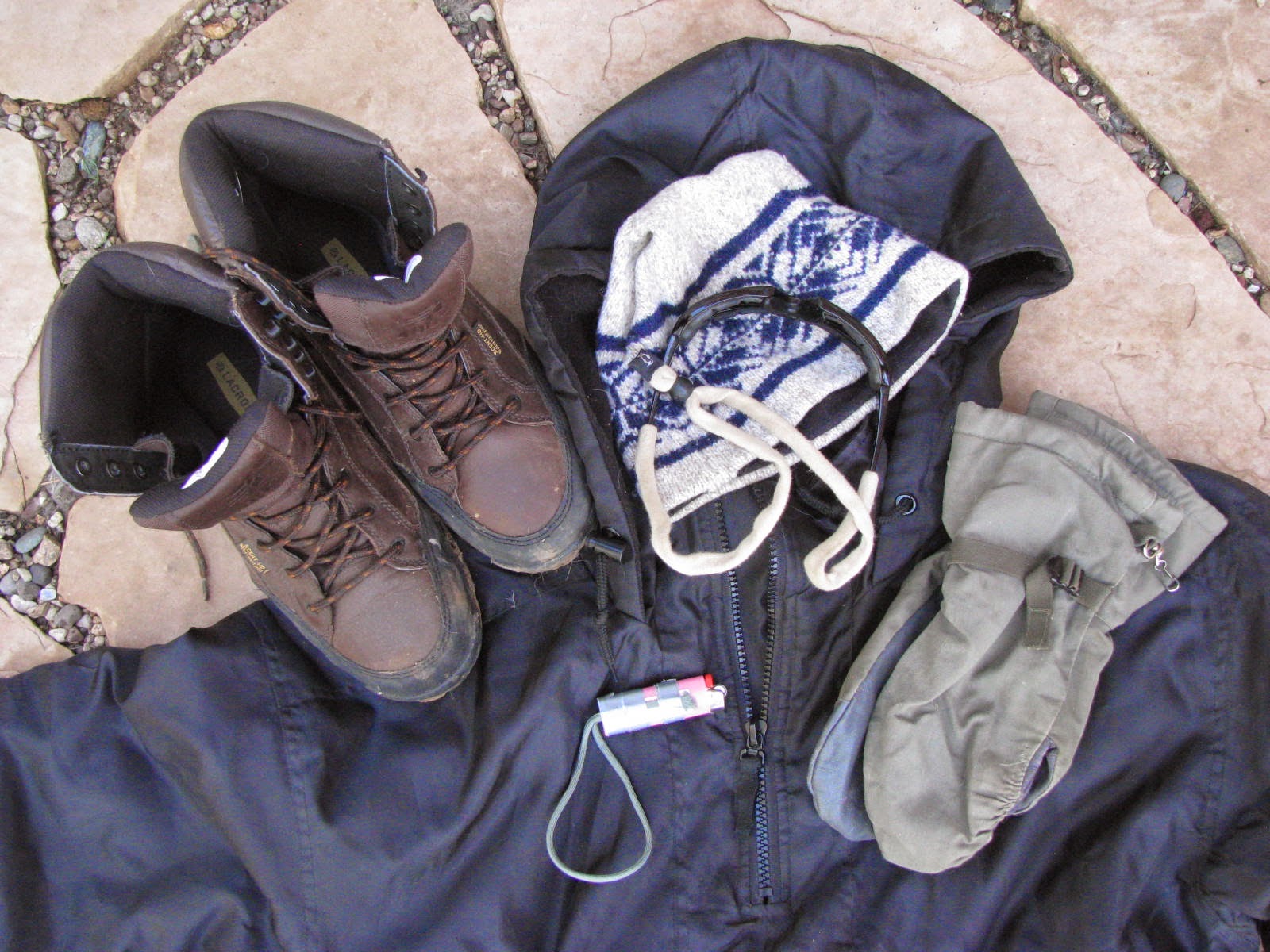
Here's my "shelter system" that's stowed in the truck:

Down jacket
Wool or fleece sweater
Mittens
Wool hat
Sorel (insulated) pacboots
Spare wool socks
Long underwear bottoms
Adventure Medical Kits Heatsheet (not the cheap Mylar blankets which only have a shelf-life of 6 months in the package)
Sleeping bag

I’ve spent too many bone-cold nights in the wilds with only the clothes on my back and have come to treasure my sleeping bag. Nowadays bags compress down to the size of a loaf of bread so we're not talking about a bulky item here. Slumberjack makes inexpensive bags in this size range or you can get a quality bag from Western Mountaineering. Carry one- you won't regret it if you become stranded on the road! Short of that, bring some wool blankets.

Hydration
Minimum of 1 gallon per person in your vehicle. I have a couple of 64 oz plastic juice containers along with two 1-quart Nalgene bottles. One of my Nalgenes is wrapped with black duct tape which will turn the bottle into a snow-melting device. Water is a critical survival item, even in the winter, so don't skimp on it.

Food
Yeah, you can go without food for weeks as real-life survivors have, but why?! I've been without grub under survival conditions for days on end and there’s nothing romantic about starving. Bring some quality food not far off from what you normally eat. Remembering that such items freeze in the colder months, I usually opt for M & Ms, a small jar of peanut butter, crackers, raisins, and jerky. I also bring along some packets of instant soup and hot cocoa (see below). If you don’t want to pack all of this, then buy some Lorna Doone Shortbread Cookies as these are high in fat and calories. On one winter survival course in the sub-arctic, we were consuming around 9000 calories a day per person so don’t rule out the importance of food during cold-weather preparations.

Miscellaneous
In addition to the sleeping bag, I also carry a Nu-Wick candle. This is a non-toxic candle in a tin that comes with 5 wicks that burns for 120 hours. You can add or subtract wicks to boost/reduce heat output and these candles can even be used for heating a small pot of soup or cocoa.

A small cooking pot or enamel cup is essential for melting snow and heating up water. Nothing fancy here- mine is a recycled peach can. A small (32 oz) apple juice can will work too or you can buy an18 oz enamel cup at Wal-Mart. In both our vehicles, we have small first-aid kits made by Adventure Medical Kits. These start at $20 and are quality kits. 

I also have a small shovel and two strips of carpet measuring 6” wide x 4 feet long for providing traction under my tires if I become stuck in the snow. This has come in handy more than a few times. Along with this is a Can of Fix-a-Flat, a Sears air-compressor ($25), and an umbrella. The latter you can use for standing over your spouse during a snow storm while they change the tire....

The Campmor company carries the aforementioned sleeping bags, Nu-Wick candles, Heatsheet, and AMK First-aid kits in addition to other outdoor gear.

What to do when stranded on the road
So, let's say you become stranded on the highway during a blizzard. Use your vehicle as a survival shelter and consider walking out as a last resort. Hopefully you topped off your fuel tank before leaving home. To conserve fuel, run your engine 15 minutes each hour to warm up the interior. IT IS ESSENTIAL TO CRACK OPEN A WINDOW! Carbon Monoxide is a silent killer so make sure your exhaust pipe (muffler pipe) outside is clear of snow and then crack the window open slightly while running your engine.

The coldest part of the vehicle will be on the floor as cold air settles so put your feet across the seat. Wrap up in your sleeping bag, put a hat on, have a snack, and settle in. It could be a while before emergency services clear the road or get to you. If you have kids, bring along extra winter clothes, food, and water. Every winter it seems that there is a disheartening story about a family who decides to take a "shortcut" home on secondary roads and becomes stranded. So plan ahead and BE PREPARED!

Take a few minutes to outfit your vehicle at home and you will be able to handle an emergency should it befall you.

Stay warm,

JT Sawyer

Tuesday, August 12, 2014

No Place to Hide - Now Available

No Place to Hide

I am thrilled to announce that the third book in the First Wave series, No Place to Hide, is now available on Kindle.

This book picks up where the second title left off. As Travis Combs and his band of fighters head for the secret lab in Durango, they face the convergence of powerful forces bent on securing the vaccine in his possession. With a traitor in their midst, and with the emerging threat of faster moving zombies, he must lead his weary group through the mountains and take the battle to his enemy.

On a related note, you can also read an interview with me on survival skills and wilderness hazards by visiting writer Fiona Quinn's website.

Take care and enjoy the wilds!
JT