Blog Archive

Showing posts with label prepping. Show all posts

Wednesday, February 18, 2015

Why Bugging-Out to the Wilds is a Bad Idea

Why Bugging-Out to the Wilds Is a Bad Deal

I get at least one comment in each of my urban survival classes about “if things go to hell in Phoenix (insert large city) then I will just grab my BOB and head to the hills and live off the land until society re-establishes itself.”

Here are some reasons why that survival-forum fantasy would suck:

1. Assuming you got out of the city early enough during that reactor meltdown or EMP blast (the two scenarios most bandied about), you will be on the road with every other dude who is maneuvering his tricked-out Hummer loaded with the latest zom-poc gear and Jack Bauer shoulder bags. This scenario is often accompanied by the comment, “If I can’t make it to my wilderness retreat, I’ll just live out of my rig while evading others and nabbing deer along the way with my suppressed carbine.” First off, when is the last time you went car-camping under non-stressful evacuation conditions while contending with resupplying water, dealing with first-aid issues, field-dressing wild game, cooking your chow over a sluggish fire in the rain, and getting used to all those nocturnal sounds outside your tent that prevent you from getting a decent night’s sleep?

2. All of the survival forums involve a bug-out situation with a lone-wolfer who is versed in shoot-and-move skills, advanced paramedic training, and has the trapping know-how of Jeremiah Johnson (the real one not the wink-at-the-camera, square-jawed Robert Redford). There’s never any mention about how, on the frantic drive away from the mushroom cloud, that you stopped at your parent’s house to grab them, their old black lab, and their satchel of prescription meds which is nearing their refill dates. Yeah, so what if your family wasn’t into the whole prepping thing and never gathered up any supplies, though you argued the merits with them after every disaster headline in the news- are you really going to duck out on them when the pigspoor hits the flywheel (PHTF)? I had one guy tell me he was gonna hoof it solo to his land in New Mexico to ride out his days there and then proceeded to ask me if I could go through his BOB and explain some of the items he had hastily packed off some forum recommendations.

3. It’s late January and you just got done working the third-shift after another twelve-hour day. Now you have to grab your kin, your gear, your pets, and negotiate traffic on your drive to the wilds to begin your post-apocalyptic campout while contending with hypothermia issues, deep snow, and a lack of wild game and edible plants (which you were going to resort to after your week-supply of yummy MREs were depleted). There are no guarantees in bugging out that you will be doing so during the day, in warm weather, when you are feeling 100% physically or mentally, you will be uninjured after the evacuation effort, and the area you end up in will have decent natural resources. It’s called survival for a reason and it’s only adventure in retrospect. There’s nothing fun or romantic about having your world torn apart by a disaster and then having to contend with life on the road or in the wilds trying to stay alive, provide security, food, water, and meet one’s most basic needs. Add to this that you have to comfort your unprepared brother in-law who has never gone without his daily energy drink (with the extra Taurine) and who thought hunting and gathering was like walking down the produce aisle but is now eyeballing your freeze-dried Thai-chicken packets. Furthermore, when was the last time that you put all your bug-out gear through the ringer and spent a night afield when the rain was pouring down to test out what worked or tried your hand at foraging and fishing?

4. Speaking of living off the land, the survival class you had a few years ago where you learned to make a snare from an SAS commando wire-saw now comes into play as your grub is running low. Only you’re scratching your head on day two after seeing the empty snare and wondering why it worked so well for that guy on the reality show-the same guy who sells bug-out bags with his patented tactical slingshot. Keep in mind that most professional trappers have years of experience on land they know extremely well, have 30-50 steel traps on them that they spend half a day setting out over a few miles of gnarly terrain, and know intimately the habits of the wild animals they are pursuing.  And even then they sometimes go home without any meat.

As escapist as it sounds to grab your go-bag and four-wheel it up to the remote mountain encampment beside the trout stream while flailing your zombie machete at anyone who squints crazily in your direction, there are a lot of negatives to retreating to the wilds. I’d rather look at bugging-out as a temporary solution to an immediate need for evacuating from your home or city, in my case, mainly due to seasonal wildfires. Statistically, you are far more likely to have to deal with hunkering down at home because of a blizzard, tropical storm, or rolling black out. If something else heads my way, I’m not going to retreat to the forest and set up a perimeter of booby traps but head to a family member’s house or hotel in another city or state until the smoke clears. Living in the bush for weeks on end with only a knife and a small survival kit is challenging under the best of conditions and with the right group. I’ll pass on the groundhog hoagies and Red Dawn E & E tactics in favor of meeting up with my family and friends at their homes and away from the mercy of the elements.

But then that Hollywood-embedded imagery in our western culture rears its head: you know the one about the ending of the world as we know it, where we are all reduced to a pioneer-era and wear buckskin robes with a an improvised rebar shank hanging off a braided 550-cord belt. Fortunately, I’ve already invested in a solar-powered, red-dot sight for my crossbow and know how to bake a mean raccoon potpie.

Saturday, December 6, 2014

First Wave Book Series Now in a Boxed Set


It has been a busy two months with finishing up the last of my survival courses for the season, working on two new non-fiction books, and turning the First Wave Series into a book bundle. The latter is now available on Amazon and will be at the sale price of .99 for the month of December. The splendid cover is due to the talents of designer Melody Simmons who has done all of my covers.

Stay tuned for another volume in the Carlie Simmons Post-Apocalyptic Thriller which will be due out later this winter.

Take care
JT

Tuesday, November 18, 2014

Winter Survival Gear


With the colder temps upon us, I have been updating the truck supplies that I carry for roadside emergencies. Each year, there are many tales of stranded motorists having to weather out a night or two on the highway when the interstate is shut down. Being prepared, as you would when hiking in the backcountry, is essential to handling a roadside emergency during the unforgiving months of winter.

Remember, even if you live in the desert Southwest like I do, it can get mighty cold and inhospitable during the winter. On a recent desert walkabout a few weeks back, the nighttime temps were averaging 21 degrees. Where else, but the desert regions of the world, can you go from worrying about heat-exhaustion during the day to hypothermia at night? Yuma, Arizona once went from 120 degrees F during the day to 34 degrees F at night!

Shelter System
Your clothing is your primary shelter system so dress appropriately when venturing out in the the elements or taking to the road. I once had to change a blow-out on the highway east of Flagstaff while driving home one December morning. I was glad I had plenty of layers as the temps hovered around 10 degrees. So, you may not even be in the wilderness when encountering Murphy's Law.

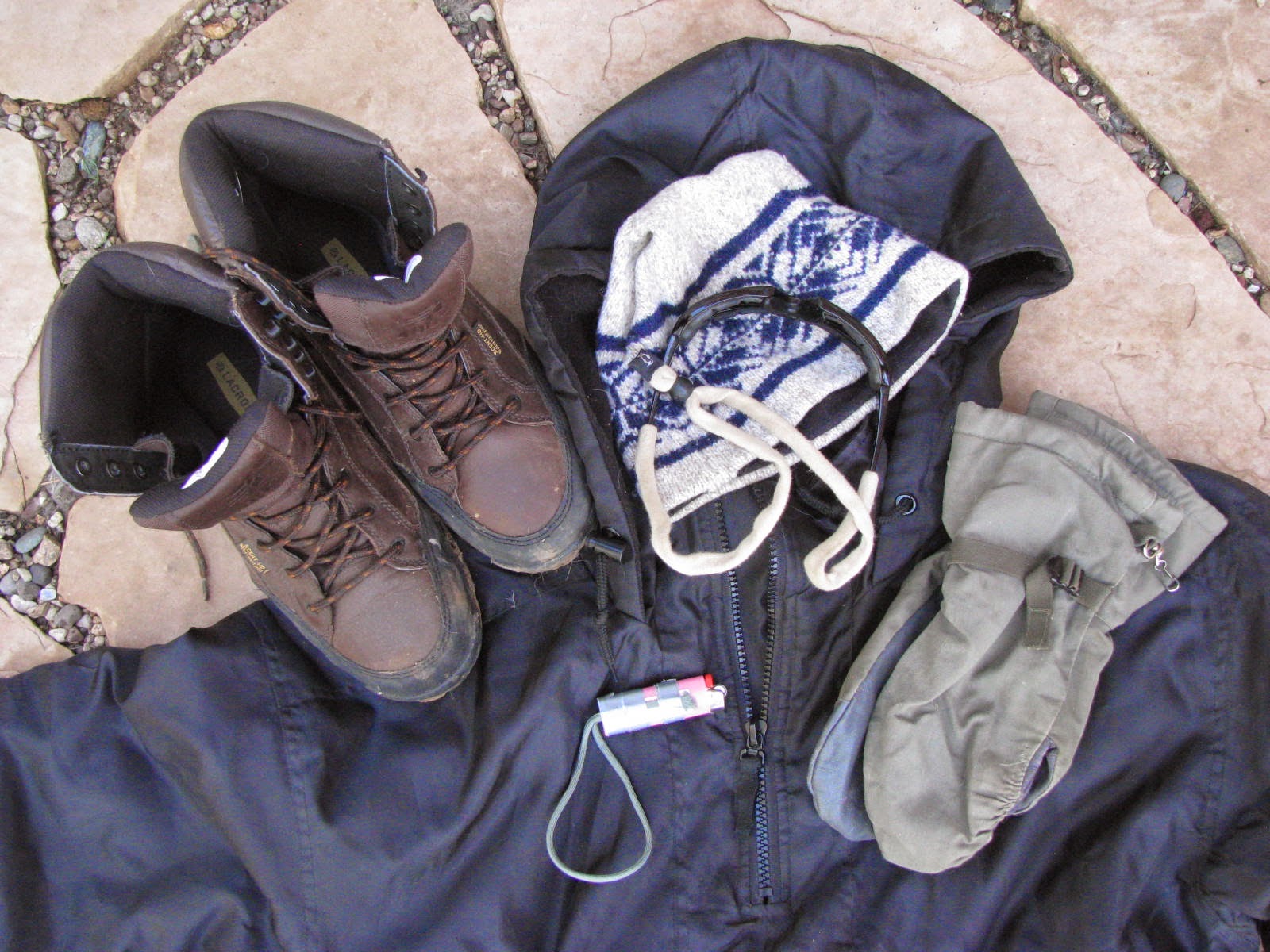
Here's my "shelter system" that's stowed in the truck:

Down jacket
Wool or fleece sweater
Mittens
Wool hat
Sorel (insulated) pacboots
Spare wool socks
Long underwear bottoms
Adventure Medical Kits Heatsheet (not the cheap Mylar blankets which only have a shelf-life of 6 months in the package)
Sleeping bag

I’ve spent too many bone-cold nights in the wilds with only the clothes on my back and have come to treasure my sleeping bag. Nowadays bags compress down to the size of a loaf of bread so we're not talking about a bulky item here. Slumberjack makes inexpensive bags in this size range or you can get a quality bag from Western Mountaineering. Carry one- you won't regret it if you become stranded on the road! Short of that, bring some wool blankets.

Hydration
Minimum of 1 gallon per person in your vehicle. I have a couple of 64 oz plastic juice containers along with two 1-quart Nalgene bottles. One of my Nalgenes is wrapped with black duct tape which will turn the bottle into a snow-melting device. Water is a critical survival item, even in the winter, so don't skimp on it.

Food
Yeah, you can go without food for weeks as real-life survivors have, but why?! I've been without grub under survival conditions for days on end and there’s nothing romantic about starving. Bring some quality food not far off from what you normally eat. Remembering that such items freeze in the colder months, I usually opt for M & Ms, a small jar of peanut butter, crackers, raisins, and jerky. I also bring along some packets of instant soup and hot cocoa (see below). If you don’t want to pack all of this, then buy some Lorna Doone Shortbread Cookies as these are high in fat and calories. On one winter survival course in the sub-arctic, we were consuming around 9000 calories a day per person so don’t rule out the importance of food during cold-weather preparations.

Miscellaneous
In addition to the sleeping bag, I also carry a Nu-Wick candle. This is a non-toxic candle in a tin that comes with 5 wicks that burns for 120 hours. You can add or subtract wicks to boost/reduce heat output and these candles can even be used for heating a small pot of soup or cocoa.

A small cooking pot or enamel cup is essential for melting snow and heating up water. Nothing fancy here- mine is a recycled peach can. A small (32 oz) apple juice can will work too or you can buy an18 oz enamel cup at Wal-Mart. In both our vehicles, we have small first-aid kits made by Adventure Medical Kits. These start at $20 and are quality kits. 

I also have a small shovel and two strips of carpet measuring 6” wide x 4 feet long for providing traction under my tires if I become stuck in the snow. This has come in handy more than a few times. Along with this is a Can of Fix-a-Flat, a Sears air-compressor ($25), and an umbrella. The latter you can use for standing over your spouse during a snow storm while they change the tire....

The Campmor company carries the aforementioned sleeping bags, Nu-Wick candles, Heatsheet, and AMK First-aid kits in addition to other outdoor gear.

What to do when stranded on the road
So, let's say you become stranded on the highway during a blizzard. Use your vehicle as a survival shelter and consider walking out as a last resort. Hopefully you topped off your fuel tank before leaving home. To conserve fuel, run your engine 15 minutes each hour to warm up the interior. IT IS ESSENTIAL TO CRACK OPEN A WINDOW! Carbon Monoxide is a silent killer so make sure your exhaust pipe (muffler pipe) outside is clear of snow and then crack the window open slightly while running your engine.

The coldest part of the vehicle will be on the floor as cold air settles so put your feet across the seat. Wrap up in your sleeping bag, put a hat on, have a snack, and settle in. It could be a while before emergency services clear the road or get to you. If you have kids, bring along extra winter clothes, food, and water. Every winter it seems that there is a disheartening story about a family who decides to take a "shortcut" home on secondary roads and becomes stranded. So plan ahead and BE PREPARED!

Take a few minutes to outfit your vehicle at home and you will be able to handle an emergency should it befall you.

Stay warm,

JT Sawyer

Tuesday, August 12, 2014

No Place to Hide - Now Available

No Place to Hide

I am thrilled to announce that the third book in the First Wave series, No Place to Hide, is now available on Kindle.

This book picks up where the second title left off. As Travis Combs and his band of fighters head for the secret lab in Durango, they face the convergence of powerful forces bent on securing the vaccine in his possession. With a traitor in their midst, and with the emerging threat of faster moving zombies, he must lead his weary group through the mountains and take the battle to his enemy.

On a related note, you can also read an interview with me on survival skills and wilderness hazards by visiting writer Fiona Quinn's website.

Take care and enjoy the wilds!
JT