Blog Archive

Showing posts with label post-apocalyptic. Show all posts

Monday, December 29, 2014

New Non-Fiction Survival Book by Tony Nester (JT Sawyer)

JT's new non-fiction book is now available on Kindle, Nook, Kobo, and other digital platforms.

Can you really get water in the desert from a solar still? Should you ever attempt to suture a wound, Rambo style, in the backcountry? What is the best treatment for a rattlesnake bite? How do you distinguish cougar tracks from dog tracks? Should you drink from your swimming pool during an urban disaster? How do you survive a night in the snow without any gear? These are just a few of the many questions survival instructor Tony Nester (JT Sawyer) answers in his informative, and at times, humorous book. Culled from the past twenty-five years of teaching, writing, and responding to readers of his popular Practical Survival book series, Tony delves into the Q & A of survival as it relates to forest, desert, jungle, and urban settings along with the often misunderstood realm of living off the land. Survival Q & A is now available as an eBook on Amazon and other ereaders.

Saturday, December 6, 2014

First Wave Book Series Now in a Boxed Set


It has been a busy two months with finishing up the last of my survival courses for the season, working on two new non-fiction books, and turning the First Wave Series into a book bundle. The latter is now available on Amazon and will be at the sale price of .99 for the month of December. The splendid cover is due to the talents of designer Melody Simmons who has done all of my covers.

Stay tuned for another volume in the Carlie Simmons Post-Apocalyptic Thriller which will be due out later this winter.

Take care
JT

Tuesday, November 18, 2014

Winter Survival Gear


With the colder temps upon us, I have been updating the truck supplies that I carry for roadside emergencies. Each year, there are many tales of stranded motorists having to weather out a night or two on the highway when the interstate is shut down. Being prepared, as you would when hiking in the backcountry, is essential to handling a roadside emergency during the unforgiving months of winter.

Remember, even if you live in the desert Southwest like I do, it can get mighty cold and inhospitable during the winter. On a recent desert walkabout a few weeks back, the nighttime temps were averaging 21 degrees. Where else, but the desert regions of the world, can you go from worrying about heat-exhaustion during the day to hypothermia at night? Yuma, Arizona once went from 120 degrees F during the day to 34 degrees F at night!

Shelter System
Your clothing is your primary shelter system so dress appropriately when venturing out in the the elements or taking to the road. I once had to change a blow-out on the highway east of Flagstaff while driving home one December morning. I was glad I had plenty of layers as the temps hovered around 10 degrees. So, you may not even be in the wilderness when encountering Murphy's Law.

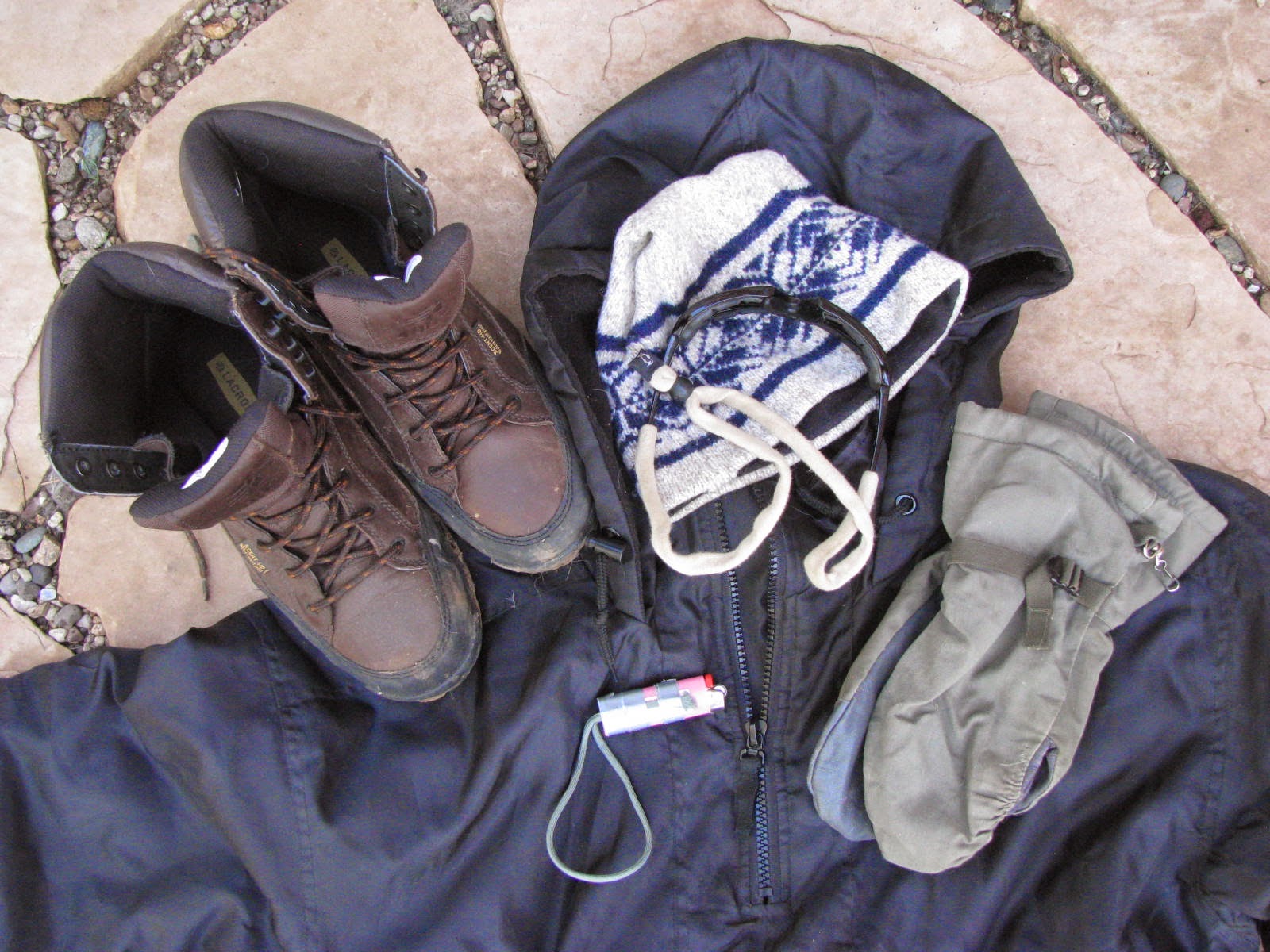
Here's my "shelter system" that's stowed in the truck:

Down jacket
Wool or fleece sweater
Mittens
Wool hat
Sorel (insulated) pacboots
Spare wool socks
Long underwear bottoms
Adventure Medical Kits Heatsheet (not the cheap Mylar blankets which only have a shelf-life of 6 months in the package)
Sleeping bag

I’ve spent too many bone-cold nights in the wilds with only the clothes on my back and have come to treasure my sleeping bag. Nowadays bags compress down to the size of a loaf of bread so we're not talking about a bulky item here. Slumberjack makes inexpensive bags in this size range or you can get a quality bag from Western Mountaineering. Carry one- you won't regret it if you become stranded on the road! Short of that, bring some wool blankets.

Hydration
Minimum of 1 gallon per person in your vehicle. I have a couple of 64 oz plastic juice containers along with two 1-quart Nalgene bottles. One of my Nalgenes is wrapped with black duct tape which will turn the bottle into a snow-melting device. Water is a critical survival item, even in the winter, so don't skimp on it.

Food
Yeah, you can go without food for weeks as real-life survivors have, but why?! I've been without grub under survival conditions for days on end and there’s nothing romantic about starving. Bring some quality food not far off from what you normally eat. Remembering that such items freeze in the colder months, I usually opt for M & Ms, a small jar of peanut butter, crackers, raisins, and jerky. I also bring along some packets of instant soup and hot cocoa (see below). If you don’t want to pack all of this, then buy some Lorna Doone Shortbread Cookies as these are high in fat and calories. On one winter survival course in the sub-arctic, we were consuming around 9000 calories a day per person so don’t rule out the importance of food during cold-weather preparations.

Miscellaneous
In addition to the sleeping bag, I also carry a Nu-Wick candle. This is a non-toxic candle in a tin that comes with 5 wicks that burns for 120 hours. You can add or subtract wicks to boost/reduce heat output and these candles can even be used for heating a small pot of soup or cocoa.

A small cooking pot or enamel cup is essential for melting snow and heating up water. Nothing fancy here- mine is a recycled peach can. A small (32 oz) apple juice can will work too or you can buy an18 oz enamel cup at Wal-Mart. In both our vehicles, we have small first-aid kits made by Adventure Medical Kits. These start at $20 and are quality kits. 

I also have a small shovel and two strips of carpet measuring 6” wide x 4 feet long for providing traction under my tires if I become stuck in the snow. This has come in handy more than a few times. Along with this is a Can of Fix-a-Flat, a Sears air-compressor ($25), and an umbrella. The latter you can use for standing over your spouse during a snow storm while they change the tire....

The Campmor company carries the aforementioned sleeping bags, Nu-Wick candles, Heatsheet, and AMK First-aid kits in addition to other outdoor gear.

What to do when stranded on the road
So, let's say you become stranded on the highway during a blizzard. Use your vehicle as a survival shelter and consider walking out as a last resort. Hopefully you topped off your fuel tank before leaving home. To conserve fuel, run your engine 15 minutes each hour to warm up the interior. IT IS ESSENTIAL TO CRACK OPEN A WINDOW! Carbon Monoxide is a silent killer so make sure your exhaust pipe (muffler pipe) outside is clear of snow and then crack the window open slightly while running your engine.

The coldest part of the vehicle will be on the floor as cold air settles so put your feet across the seat. Wrap up in your sleeping bag, put a hat on, have a snack, and settle in. It could be a while before emergency services clear the road or get to you. If you have kids, bring along extra winter clothes, food, and water. Every winter it seems that there is a disheartening story about a family who decides to take a "shortcut" home on secondary roads and becomes stranded. So plan ahead and BE PREPARED!

Take a few minutes to outfit your vehicle at home and you will be able to handle an emergency should it befall you.

Stay warm,

JT Sawyer

Tuesday, August 12, 2014

No Place to Hide - Now Available

No Place to Hide

I am thrilled to announce that the third book in the First Wave series, No Place to Hide, is now available on Kindle.

This book picks up where the second title left off. As Travis Combs and his band of fighters head for the secret lab in Durango, they face the convergence of powerful forces bent on securing the vaccine in his possession. With a traitor in their midst, and with the emerging threat of faster moving zombies, he must lead his weary group through the mountains and take the battle to his enemy.

On a related note, you can also read an interview with me on survival skills and wilderness hazards by visiting writer Fiona Quinn's website.

Take care and enjoy the wilds!
JT