Blog Archive

Saturday, December 6, 2014

First Wave Book Series Now in a Boxed Set


It has been a busy two months with finishing up the last of my survival courses for the season, working on two new non-fiction books, and turning the First Wave Series into a book bundle. The latter is now available on Amazon and will be at the sale price of .99 for the month of December. The splendid cover is due to the talents of designer Melody Simmons who has done all of my covers.

Stay tuned for another volume in the Carlie Simmons Post-Apocalyptic Thriller which will be due out later this winter.

Take care
JT

Tuesday, November 18, 2014

Winter Survival Gear


With the colder temps upon us, I have been updating the truck supplies that I carry for roadside emergencies. Each year, there are many tales of stranded motorists having to weather out a night or two on the highway when the interstate is shut down. Being prepared, as you would when hiking in the backcountry, is essential to handling a roadside emergency during the unforgiving months of winter.

Remember, even if you live in the desert Southwest like I do, it can get mighty cold and inhospitable during the winter. On a recent desert walkabout a few weeks back, the nighttime temps were averaging 21 degrees. Where else, but the desert regions of the world, can you go from worrying about heat-exhaustion during the day to hypothermia at night? Yuma, Arizona once went from 120 degrees F during the day to 34 degrees F at night!

Shelter System
Your clothing is your primary shelter system so dress appropriately when venturing out in the the elements or taking to the road. I once had to change a blow-out on the highway east of Flagstaff while driving home one December morning. I was glad I had plenty of layers as the temps hovered around 10 degrees. So, you may not even be in the wilderness when encountering Murphy's Law.

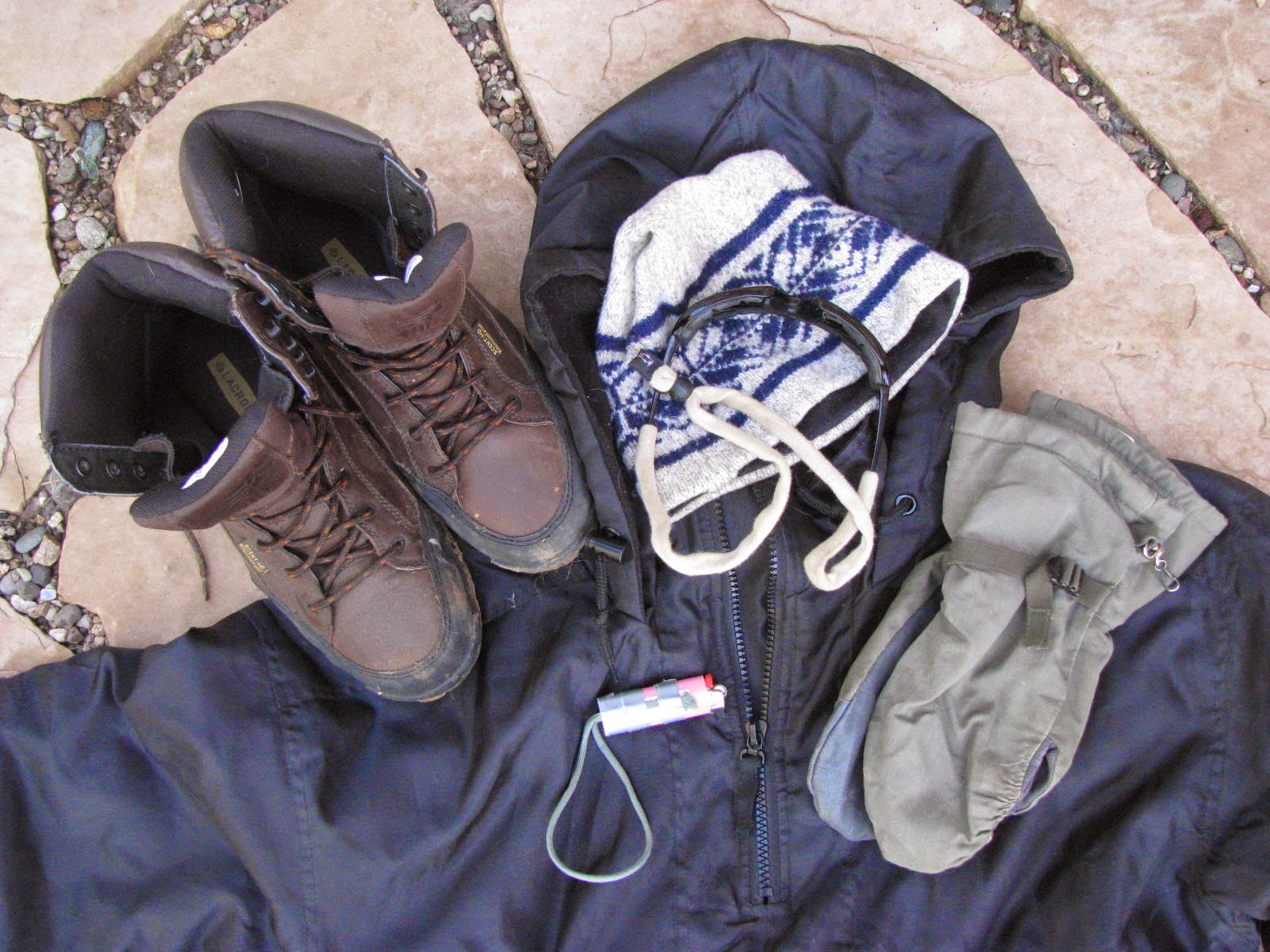
Here's my "shelter system" that's stowed in the truck:

Down jacket
Wool or fleece sweater
Mittens
Wool hat
Sorel (insulated) pacboots
Spare wool socks
Long underwear bottoms
Adventure Medical Kits Heatsheet (not the cheap Mylar blankets which only have a shelf-life of 6 months in the package)
Sleeping bag

I’ve spent too many bone-cold nights in the wilds with only the clothes on my back and have come to treasure my sleeping bag. Nowadays bags compress down to the size of a loaf of bread so we're not talking about a bulky item here. Slumberjack makes inexpensive bags in this size range or you can get a quality bag from Western Mountaineering. Carry one- you won't regret it if you become stranded on the road! Short of that, bring some wool blankets.

Hydration
Minimum of 1 gallon per person in your vehicle. I have a couple of 64 oz plastic juice containers along with two 1-quart Nalgene bottles. One of my Nalgenes is wrapped with black duct tape which will turn the bottle into a snow-melting device. Water is a critical survival item, even in the winter, so don't skimp on it.

Food
Yeah, you can go without food for weeks as real-life survivors have, but why?! I've been without grub under survival conditions for days on end and there’s nothing romantic about starving. Bring some quality food not far off from what you normally eat. Remembering that such items freeze in the colder months, I usually opt for M & Ms, a small jar of peanut butter, crackers, raisins, and jerky. I also bring along some packets of instant soup and hot cocoa (see below). If you don’t want to pack all of this, then buy some Lorna Doone Shortbread Cookies as these are high in fat and calories. On one winter survival course in the sub-arctic, we were consuming around 9000 calories a day per person so don’t rule out the importance of food during cold-weather preparations.

Miscellaneous
In addition to the sleeping bag, I also carry a Nu-Wick candle. This is a non-toxic candle in a tin that comes with 5 wicks that burns for 120 hours. You can add or subtract wicks to boost/reduce heat output and these candles can even be used for heating a small pot of soup or cocoa.

A small cooking pot or enamel cup is essential for melting snow and heating up water. Nothing fancy here- mine is a recycled peach can. A small (32 oz) apple juice can will work too or you can buy an18 oz enamel cup at Wal-Mart. In both our vehicles, we have small first-aid kits made by Adventure Medical Kits. These start at $20 and are quality kits. 

I also have a small shovel and two strips of carpet measuring 6” wide x 4 feet long for providing traction under my tires if I become stuck in the snow. This has come in handy more than a few times. Along with this is a Can of Fix-a-Flat, a Sears air-compressor ($25), and an umbrella. The latter you can use for standing over your spouse during a snow storm while they change the tire....

The Campmor company carries the aforementioned sleeping bags, Nu-Wick candles, Heatsheet, and AMK First-aid kits in addition to other outdoor gear.

What to do when stranded on the road
So, let's say you become stranded on the highway during a blizzard. Use your vehicle as a survival shelter and consider walking out as a last resort. Hopefully you topped off your fuel tank before leaving home. To conserve fuel, run your engine 15 minutes each hour to warm up the interior. IT IS ESSENTIAL TO CRACK OPEN A WINDOW! Carbon Monoxide is a silent killer so make sure your exhaust pipe (muffler pipe) outside is clear of snow and then crack the window open slightly while running your engine.

The coldest part of the vehicle will be on the floor as cold air settles so put your feet across the seat. Wrap up in your sleeping bag, put a hat on, have a snack, and settle in. It could be a while before emergency services clear the road or get to you. If you have kids, bring along extra winter clothes, food, and water. Every winter it seems that there is a disheartening story about a family who decides to take a "shortcut" home on secondary roads and becomes stranded. So plan ahead and BE PREPARED!

Take a few minutes to outfit your vehicle at home and you will be able to handle an emergency should it befall you.

Stay warm,

JT Sawyer

Friday, November 7, 2014

Bug-Out Gear for Travelers


Bug-Out Gear for Travelers

I travel a great deal in my work as a survival instructor. For much of my that time, I can easily pack up my truck and have enough gear to take care of my needs on the road for a week. At other times, I fly throughout the US or abroad and all of my well-laid plans for a bug-out bag modified drastically to comply with various federal and international restrictions.

I think this is the case for many travelers who are preparedness-minded. You have well-thought plans for handling a grid-down crisis at home or evacuating your city during an urban disaster complete with bug-out gear, a well-stocked vehicle, and contingency plans if the routes out of Dodge are congested. However, when you fly with restriction on your gear, you are thrust into an unfamiliar world where the location of medical resources, water, power supply capabilities, and major highways are vague or unknown altogether.

Having a few critical items and plans in place prior to boarding a plane or heading to another state can provide you with peace of mind and enable you to handle a crisis away from home.


A Carry-On Bug-Out Bag

I like having a small US Palm or 5.11 daypack with me on trips. These are built for rough use and are in the 2500-3000 cubic inch range allowing them to store snugly under my seat. In this daypack, I carry my laptop, shemagh, rain jacket along with extra food and clothes. These items are kept apart from the small bug-out bag that follows.


Within this daypack I have a small detachable pouch that contains the critical bug-out gear. I have also used Pelican and Otter boxes and BDU Wallets but find the shoulder bag to be very compact and unobtrusive. There are also shoulder bags designed for tablets that are ideal. Remember that in a true disaster, you may be donning your gear for several days so purchase something that works for your body type and comfort level.


The diminutive pouch is kept within reach at the top of my pack. When I am out and about in the city or any time I am away from my hotel, it’s with me--- no exceptions. This is in addition to the previously mentioned Everyday Carry Gear in my pockets. This gear will at least allow you to deal minor emergencies in the event of a grid-down scenario where you are stuck on the couch for several days in Terminal Two.


The following is what I carry in my kit. A detailed description of each item and the reasoning behind it follows the list. I am already assuming you will have your cellphone, cash, passport, etc...on you.


Bug-Out Gear

Potable Aqua Chlorine Dioxide Water Purification Tablets

2 N95 Dust Masks

Adventure Medical Kits Heatsheet Space Blanket

Leather Gloves

Mini-Roll of Duct Tape

3 Myoplex Meal Replacement Bars

Spare Prescription Glasses 

Wet Wipes

Cellphone Charger

Universal Power Adapter

1-Person First-Aid Kit by Adventure Medical Kits


Obviously a knife is left off this list as the regulations vary tremendously from state to state as well as with international travel. You will need to check with TSA or Amtrak on their specific regulations and then for the given state or country you will be visiting. When I travel to Latin America I often come back with several machetes in my checked luggage and have never had a problem, even after an inspection. This is in addition to the Mora knife, Spyderco Endura, and Leatherman that accompany me in my checked luggage. Any blades are secured in their sheath with a zip-tie or duct tape to prevent an accidental opening during baggage handling.

Additional Gear to Purchase after Arrival

When you disembark a plane or train, you already have a bug-out kit that will take care of a portion of your survival priorities. You need to make a quick stop at a big-box or grocery store to cover the rest of your needs.

Depending on the length of your trip, time of year and geographic location, you may want to flesh this list out far more than what I have here but this is a place to start for augmenting your existing gear. 


Water

Three 1-liter bottles is a good place to start. In addition to staying hydrated, you have a simple means of purifying water using the Sodis Method. Visit their site and see for yourself how this low-tech method works using clear plastic bottles and UV rays. It’s an excellent technique to file away between your ears.


Sunscreen

A small tube, rather than a spray bottle. According to the latest research, SPF 30 is all that’s needed.


Bic Lighters

Enough said! One of anything critical is a weak set-up so I pick up two lighters and then leave them behind when I fly home.


Three Days of No-Cook Foods

Purchase some packets of tuna, jerky or freeze-dried meals. I also add in bouillon cubes which are a great additive to hot water for making a quick broth on cold days and it helps with replacing lost sodium. If you are a fan of MREs then, by all means, bring some along. From past experience, there is no way I am going to get that “food” down my gullet and my menu reflects that. If you have rations in your kit, then try it out long before you plan on using it. Some of the items on the market are comparable to chalk and will be hard to gag down in a true crisis.


You want to strive for roughly 2000 calories a day. Yes, you can live on survival rations averaging 1000 calories a day, as the packages indicate, but that’s a road to mental anarchy. Survival is hard enough so don’t skimp on quality food when assembling a bug-out bag.


My usual menu is to purchase one packet each of tuna, jerky and a freeze-dried meal per day. Even when I am traveling throughout the U.S in my truck I have three days’ worth of this chow in my rig.


Preparedness Gear to Have in Your Rental Vehicle

When I need to rent a vehicle during a trip, I purchase the following items (*) prior to leaving the city near the airport. The remaining items are brought with me from home and placed in my checked luggage.


2+ gallons of water depending on location and time of year*


Can of Fix-a-Flat* Tire Repair Sealant


18 ounce Coleman Stainless Steel Mug for heating water, melting snow, and more.


Cellphone Vehicle Charger

This article is an excerpt from Tony's (JT's) eBook, Bug-Out Gear for Travelers

Sunday, November 2, 2014

Emergency Food Supplies

Types of Food to Stock Up On
I sometimes have people in my survival courses who confide that their emergency food storage consists of 6 months of MREs or a 30-day supply of Ramen Noodles.

There’s nothing wrong with having the above chow on hand in limited quantity. I carry a few MREs in my truck for a roadside emergency but I sure don’t want to live off such synthetic stuff for a couple of months. I also know that the color will drain out of my kids’ faces if they are ever confronted with an MRE again. Save this "food" for the Bug-out Bag and invest in items that you normally eat at home until you have at least a 7-30 day supply. You want to strive for around 2000 calories a day per person.


There are 3 areas to plan for:

Dried Goods- rice, oats, lentils, millet, beans, green peas, brown sugar, coffee, tea, pasta, flour, dried soup mixes, wheat and barley to name some of what we have in storage. Personally, I have lived on rice and lentils for dinner and oats for breakfast for up to 21 days straight on long-term wilderness treks and my body did extremely well. Rice and lentils provides a complete protein and plenty of carbs. Tabasco was a good friend with such an unchanging menu.

Canned Goods- Stock up on your favorites by purchasing 3 cans more of what you normally eat on each trip to the grocery store. In our household, we have the following on hand: corn, pinto and black beans, green beans, pumpkin (great for mixing into pancakes and muffins), pineapple, tuna, diced tomatos, ham, chicken, tuna, pears, and squash.

Dehydrated and Freeze-Dried Food- My advice is to go to an outdoor gear shop and purchase a few of the different brands of dehydrated meals first before investing in a few hundred bucks of SHTF supplies that may have a considerable gag factor. These meals are also intended for people who exert themselves (backpacking, canoeing, etc… ) and need to replace lost salts so some of the meals contain up to 56% sodium.

Mountain House and AlpineAire can both be found at outdoor gear shops. Walton Feed and Wise Foods also sell high-quality items such as dehydrated veges and even canned butter. Most these brands have a shelf-life of 5-20 years and require a cup or two of boiling water to rehydrate. Again, sample things and see what tastes good, especially if you're planning on living on these for a few months. 


Strive for a minimum supply of food for 7 days and then work up to more if your budget and storage abilities allow for it.

Saturday, October 25, 2014

Grid-Down Tools for Travelers


 A Few Tools for Travelers and Off-Grid Situations
 
As I spend a lot of time on the road teaching, I've been trying out a number of portable power-devices for keeping the Smartphone, Kindle, and laptop charged. There are some excellent items out there now that should be considered if you log a lot of hours in airports, on the road, or simply want to have a lo-tech energy supply, for small devices, at home in the event of an emergency.

The Anker 2nd Gen Astro3 is probably my favorite and most-used. This costs around $50 and will hold approximately 500 charges over its lifetime. I plug mine into a wall outlet or laptop at home for initial charging and then it will charge my Iphone or Kindle several times before it needs recharging. Joos is another option, costs around $140, and is solar-powered. This is a sturdily constructed device for those in sunny regions and holds up better in the field. Lastly, you can pick up a Mophie Powerstation at your local Verizon store for around $75. This can be used in a similar fashion to the Anker charger.

Tuesday, August 12, 2014

No Place to Hide - Now Available

No Place to Hide

I am thrilled to announce that the third book in the First Wave series, No Place to Hide, is now available on Kindle.

This book picks up where the second title left off. As Travis Combs and his band of fighters head for the secret lab in Durango, they face the convergence of powerful forces bent on securing the vaccine in his possession. With a traitor in their midst, and with the emerging threat of faster moving zombies, he must lead his weary group through the mountains and take the battle to his enemy.

On a related note, you can also read an interview with me on survival skills and wilderness hazards by visiting writer Fiona Quinn's website.

Take care and enjoy the wilds!
JT